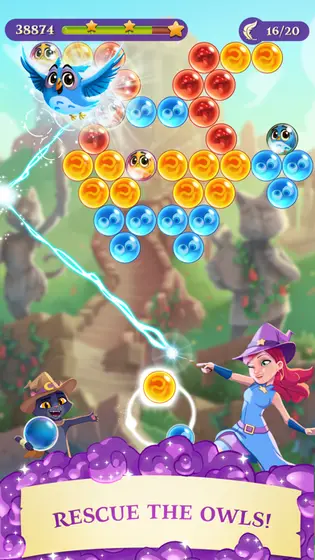
Shooter boards look like the simplest thing in casual puzzles and are scored on a rule most players never consciously learn: anything not connected to the anchor falls, whatever colour it is.
The rule that decides these levels
The cluster hangs from something: the ceiling, a beam, a fixed anchor point. Matching three of a colour removes those three. But anything left hanging with no path back to the anchor also falls, regardless of colour, size or how well it was placed.
That second sentence is where all the value is. A three-match that removes three tiles is small. A three-match that severs the last connection holding up twenty tiles removes twenty-three. Both cost one shot.
Look for the neck, not the colour
Every hanging cluster has one or two narrow points where a large section connects to the rest. Find those before you look at colours. If you can break the neck, the section below it falls whole, and there is rarely a more efficient shot available on the board.
The habit that separates people who find these levels easy from people who find them frustrating is scanning the shape first and the colours second. Colour matching is what the game shows you; structure is what the game scores.

Bank shots
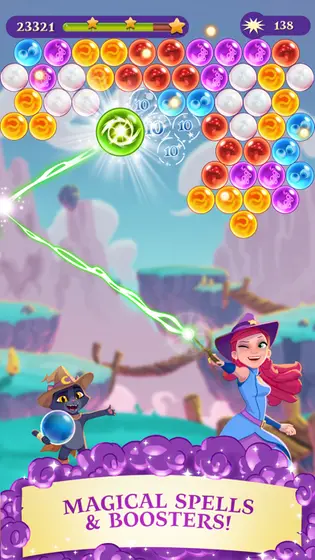
The aim line reflects off the side walls at an equal angle, and never off the ceiling. That makes the sides a tool rather than a boundary: a bounce reaches positions tucked under an overhang that no direct line can touch, and on later levels those positions are usually where the anchor sits.
Estimating the angle is easier than it looks if you pick the point on the wall rather than the target. Aim at a spot on the wall level with your intended landing, and the reflection tends to land close. Most games also extend the guide line as you progress, which turns estimation into reading.
When a level looks impossible, check whether the shot exists as a bank shot. On boards with a heavy overhang, the intended solution is frequently a bounce, and the level is only unfair if you insist on shooting straight.
Managing the shot queue
These games show the next projectile, and often the one after. That is planning information, not decoration. If the current colour has no useful target but the next one does, the correct play is often to park the current shot somewhere harmless where it improves a future match, rather than forcing it into a bad position.
Parking well is a real skill. A parked tile should sit next to two others of its colour so it becomes a target later, and it should never extend the cluster downwards, because on most of these boards letting the cluster reach the bottom line ends the level immediately.
The descending ceiling
Many levels drop the whole cluster by a row after a set number of shots. This converts the level into a race and changes what a wasted shot costs: not just the shot, but a fraction of the total space you have left.
When a descent is coming, prefer shots that reduce the height of the cluster over shots that merely clear colour. A wide clear at the bottom edge buys the same room as several tidy matches higher up, and it buys it where the pressure actually is.
What does not transfer from grid puzzles
Almost nothing about grid technique applies here. There is no gravity in your favour, no cascade loop, and no special-tile shape language. What replaces them is structural reading: where the anchor is, where the necks are, and how the shape changes as it falls. Players who arrive from swap boards usually try to clear tidily and lose to players who shoot at what appears to be nothing and drop half the screen.